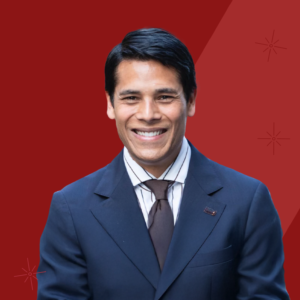
Todd Silverstein spoke with Joseph Pigato, President of Stanford Entrepreneurs, during an interview session. Silverstein is a producer and lead technical consultant for HBO’s Emmy-winning series Silicon Valley. A seasoned entrepreneur, he previously founded Vizify-later acquired by Yahoo-and went on to establish Narō in Tokyo. He currently serves as Chief Product Officer at iKHOR Labs, an AI animation company based in Tokyo. Silverstein holds an MBA from the Wharton School and a BA from Cornell University in Computer Science, Anthropology, and Literature.
Stanford Entrepreneurs: You had an unconventional path from tech entrepreneur to Hollywood writer. Can you walk us through how you got involved with Silicon Valley?
Todd Silverstein (TS): I got a little bit lucky. There’s a guy named Jonathan Doten who had worked with Mike Judge, and they started involving people from Silicon Valley from season one to get story ideas. Dick Costolo ended up sitting in the writers room for big chunks of Season 2, as did Mark Pincus. But they realized they wanted someone more on the ground day to day.
They actually recruited through a bunch of VCs and other networks. One of the other founders who had been acquired at Yahoo heard from his investors saying, “Hey, Silicon Valley is looking for this,” and he told me, “Todd, I’m reading the job description-you got to apply.” I applied thinking there’s no way I’m gonna get any call back from them. Surprisingly, 24 hours later they called me back and said, “Hey, do you want to interview for this position?” I was like, “Hell yeah, I do.”
Stanford Entrepreneurs: What was your first day on set like? That had to be a very different environment from the startup world.
TS: It was definitely daunting and a little bit frightening. Jonathan fortunately tried to ease me into it. What ended up surprising me is not just how amazing and professional everyone involved with the show was, but fundamentally how nice they were. It was one of the most high-performing teams I’ve ever had the opportunity to work with.
We were filming on the Culver City Sony Lot—there’s like one of the Ghostbuster cars on the lot, all this movie history around you. But the offices actually reminded me of most startup offices. The buildings are underneath the fancy paint job and facade kind of run down, and you end up in more or less a conference room with a lot of whiteboards, with a group of people working for hours on end. Very quickly it felt like, “Oh yeah, this feels sort of like a startup in its own way.”
Stanford Entrepreneurs: What exactly did your role as technical consultant involve?
TS: Mike Judge has an engineering background—he actually worked at Raytheon before Beavis and Butthead. Part of the magic of the show is he was like, “If we’re going to do this, we don’t just want it to be a sitcom that just happens to be based in tech. We have to get this right.”
I was in the writer’s room with the writers every day performing a couple of functions. One was feeding them stories-I’d go out to my network asking, “Tell me some of the craziest things that have happened to you in your startup experience.” The writers would do these wonderful reinventions or twists on them.
Beyond that, in any scene where there was a technical artifact that would appear, we got special dispensation to build those ourselves. In a 30-page script, we would typically create 50 to 60 artifacts. If there’s going to be a screen visible on scene, we needed to provide code for that. Finally, in post-production, I was responsible with a group of people for reviewing all of the footage for technical accuracy.
Stanford Entrepreneurs: Did the actors actually understand the technology they were portraying?
TS: For the most part, even though it looks realistic and the dialogue is realistic, these are actors. While many of them were interested in tech, their understanding did tend to be limited. There were times where we’d be like, “Hey, use your keyboard to do a commit,” and they’d be like, “I feel like using the mouse here,” and then we’d have to go to the director.
Jimmy O-Yang was super interested in technology and went on to become an investor. Tim and I would go out for coffees with him and teach him about tech. But that was the exception rather than the rule.
Stanford Entrepreneurs: You helped create the famous “Hot Dog, Not Hot Dog” app. How did that come about?
TS: That started as a joke in the script—Jin Yang’s building an app that only does one thing really well. The writers converged on hot dog detection. Tim Anglade, who had been working with me as a consultant, and I had been playing around with some emerging AI technologies. We pitched Mike and Alec: “We actually think we could build this thing and get an app out.”
It almost got shut down by the HBO legal team because they were worried about risque photos being uploaded. We found a way to shrink the algorithm so it could run entirely locally on the device. As far as I know, it was the first app ever shipped to the app store that did an AI computation entirely locally on the device. People still come up to me and are like, “Yeah, I got the app—let’s take a picture.” It delights me that this thing has taken on a life of its own.
Stanford Entrepreneurs: How did you balance technical accuracy with the need for comedy?
TS: The constant note you get back is “do it in 8 words.” If you think about a script, it’s 30 pages, about a minute per page, and they want to have jokes—they don’t want technical explanation. The challenge was always: How do you get it accurate and condense it? If you actually look at the word count, it was always like less than 10 words.
Sometimes Jonathan and I would just be pulling our hair because we’re like, “We cannot make this any shorter.” But inevitably it would get cut in editing if it was longer than that. The goal was always to make it accurate, but make it accurate really fast.
Stanford Entrepreneurs: The show resonated with both tech insiders and general audiences. How did you achieve that balance?
TS: The show struggled early on because people thought it was a show about tech, and if they’re like, “Yeah, I’m not interested in tech.” But then word got out: “Oh, you don’t need to pay attention to that. It’s just funny.”
The stories started as human stories. While those were located in tech, the writing process was: let’s find a satisfying story, let’s ensure it’s accurate in the tech world, and then almost third was let’s make it funny by adding the jokes. Alec used to joke—and he could say this because he’s so brilliantly funny—”Oh, the jokes are easy.” The part they agonized about was constructing these stories and building the stories.
Stanford Entrepreneurs: Will there ever be another season or follow-up?
TS: I would never say never, but both Alec and Mike have moved on to other projects, and this wouldn’t happen without them. Towards the end, getting set time for the actors became really complicated as their careers took off.
One thing that was talked about in the writers room is that tech maybe isn’t quite so fun anymore. There’s a lot of darkness—election manipulation, power, and other issues. The time and the tech landscape, and how tech is viewed in society, have shifted in a way that I’m not sure Mike and Alec would be like, “Oh, this is such a fun field to be operating in anymore.”
Stanford Entrepreneurs: You’re now working in Japan’s startup scene. How does that compare to Silicon Valley?
TS: Traditionally in Japan, failure carried a much higher price, so the best and brightest wanted to go to traditional salaried jobs. Even though the markets fell apart in the eighties, the culture has been much slower to respond.
In the last five years I’ve been here, I’ve seen movement. Startups are becoming something that really talented young people are getting much more interested in. Partially, they feel like the traditional routes of career success don’t work anymore. The startup community here feels very tight knit.
There’s been a big infusion of people looking at Japan because the yen is cheap, plus they now have a high skills professional visa that makes it easier to come over. It’s this interesting mix of expats who have been inside big Silicon Valley startups coming into the scene, and young people choosing to go that route.
Stanford Entrepreneurs: Any final thoughts on that random opportunity that changed your trajectory?
TS: It was such a random opportunity, but if nothing else, it’s reinforced for me that sometimes, if life throws you a completely out of left field opportunity, you should take it. I certainly was really glad that I made that jump and had the privilege of having that experience.
The day-to-day work felt very much like my startup experiences-exhilarating and intense, but exhausting. A lot of whiteboarding, grinding, throwing things away, re-breaking stories. You’d think you cracked the story, then come in the next day and realize there’s a fatal flaw and have to start all over again. It felt very much like that startup experience, that search for product-market fit.
This transcript has been lightly edited and condensed.